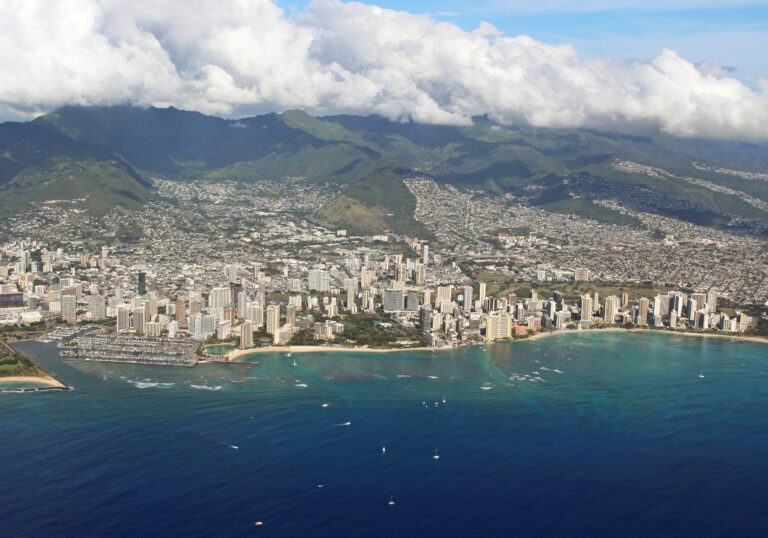
Living in Hawaiʻi is often considered a privilege because of its beauty and laid-back lifestyle. Regardless, too many people are “priced out of paradise” due to the high cost of living, lack of job opportunities, and high taxes. According to a 2024 State of ALICE in Hawaiʻi report, one in three families consider moving to the continent. Despite the decreasing population and economic issues that ensue, Hawaiʻi’s legislature has not done enough to keep their people home.
Unaffordability begins with Hawaiʻi’s restrictive zoning regulations. According to the Grassroot Institute of Hawaiʻi, only about 5% of the state’s land is zoned for urban development, where most housing can legally be built. Although intended to protect local lands from new infrastructure, this type of zoning regulation hurts the locals. Regulations also strictly permit high-rise apartment complexes and single-family homes to be constructed even though most families can only afford smaller living spaces such as duplexes and ADUs. To fix this, the Grassroot Institute of Hawaiʻi helped propose two bills that aimed to relax zoning requirements so that more homes could be turned into multiple dwellings, and permit the conversion of office buildings into micro-units or duplexes. However, in fiscal 2025, two years after the bills were passed, Hawaiʻi was among the top states for dwindling population, with many citing the lack of affordable housing as a major factor in leaving the state.
In addition to the zoning woes, high taxes largely contribute to the high cost of living, yet tax cuts are not enough to compensate. Hawaiʻi ranks first in the nation for the overall tax burden with a rate of 13.92%. This can be especially hard for Hawaiʻi’s small business owners who make up the majority of Hawaiʻi’s business industry. Certain tax cuts like the Green Affordability Plan II attempt to ease the tax burden. However as the population decreases, lessening the number of taxpayers, tax rates inevitably increase for those who stay. Additionally, government projects such as the rail or stadium improvements, while developed with good intentions, have flawed execution, adding a major financial burden. So while tax cuts are helpful, reducing government spending is equally as necessary.
In addition to the economic hardship locals face, the lack of job opportunities is another factor that pushes people toward moving. Though there are jobs available in Hawaiʻi, the continent offers more opportunities in multiple fields that allow young people to get ahead in their career. Because of this, many of Hawaiʻi’s youth do not return home after college, hence the term “brain drain.” A 2024 Hawai‘i Affordability Survey commissioned by the Holomua Collective found that about 70% of 1,500 local workers—most of whom have lived with a stable income for most of their lives—said they have considered moving to a less expensive state. This survey highlights a harsh reality: even those with stable jobs are struggling to make it in the islands. For the next generation searching for high-paying jobs, the best options lie elsewhere.
Certainly, the decision to leave is not an easy one, especially for those born and raised in Hawaiʻi who want to raise their own families here. I hope to eventually settle down in Hawaiʻi because I want my children to grow up knowing Hawaiʻi’s unique, rich culture and loving community. However, there is concern that it might not be financially wise to stay, and I am not alone in this worry. Although there have been attempts toward improving Hawaiʻi’s affordability, it is not enough when the decreasing population is struggling to fund the state’s expenses. Kama`aina are desperate for change. Until then, the high cost of living continues to be an ongoing issue that creates financial stress and leaves the future uncertain for the people of Hawaiʻi.